

Against the Single Climax
An opening into the complexities of looking, wanting, making art of the body

The part I love most about writing a book is the part that doesn’t look like writing at all. It is the gathering, the drifting toward, the slow, attentive seduction of experience. Research, we call it, as if it were sterile. But for me it is sensual, embodied: reading until my body hums with someone else’s language, traveling until a place imprints itself on my nervous system, listening so closely to another person’s story that it rearranges my own. I want to feel something so completely that when I render it in words, it carries a pulse. I test this by reading aloud. If the listener’s body answers mine — if something in them tightens, opens, recognizes — then I know I have come close.
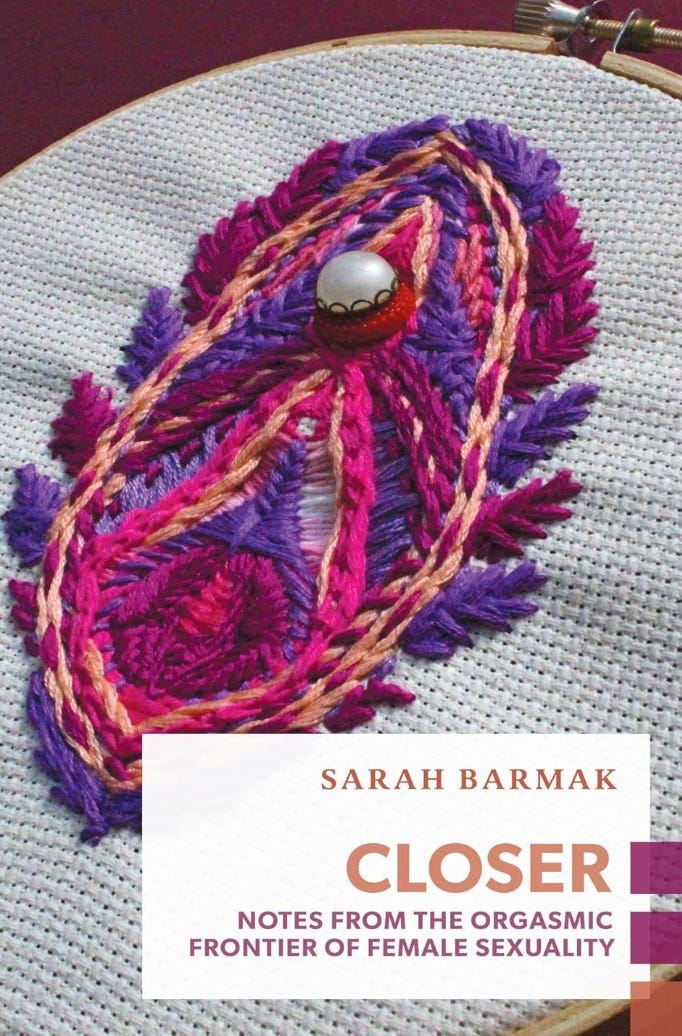
This desire to transmit not just meaning but sensation has always felt in tension with the inherited architectures of story. Or perhaps not in tension, but in refusal. When I first encountered Closer: Notes from the Orgasmic Frontier of Female Sexuality by Sarah Barmak, what held me was not the subtitle, though it promised inquiry I craved, but the image of a crocheted vulva on the cover. Soft, handmade, unapologetically literal. It felt like a thesis before I even opened the book: that we have been given the wrong textures for talking about the body, especially the erotic body, especially the female one.
Inside, Barmak writes that language itself has failed to capture women’s erotic interiority, that it requires new structures, new vocabularies. I felt a recognition that was almost grief. Not only because I believed her, but because I had already been circling this absence without naming it.
Years earlier, in my MFA program, I had been tasked with teaching a craft seminar. I chose the Hero’s Journey, that enduring map of narrative made famous by Joseph Campbell: the departure, the initiation, the return. A young man leaves home, encounters trials, achieves a singular climax, and returns transformed, bearing a prize. It is elegant, persuasive, and everywhere.
I remember standing before a room of writers, arguing both for and against it. Yes, story is in our DNA, I said. Yes, we are pattern-seeking creatures, hungry for arcs that resolve. But must the arc always crest once? Must the transformation hinge on a single, decisive victory? Must the protagonist always leave, conquer, and come back?
What if a story swells instead of peaks? What if it moves like a body rather than a blade — circling, returning, building, dissolving, building again? What if it is not about conquest but about contact? Not a climax but many, not an ending but a continuation that alters the terms of beginning?
Even then, I sensed I was not just talking about narrative, but about desire. About the ways we have been taught to move through experience: linearly, efficiently, toward a goal that can be named and displayed. And the ways that other modes — slower, recursive, diffuse — are dismissed as indulgent or incoherent, when in fact they might be truer to certain kinds of lives.
What I did not say, because I did not yet know how, was that my own life was already resisting the single-arc story. It was, in fact, becoming something messier, more plural, more alive.
There was a woman in that seminar. Beautiful is too simple a word, though it was the first that came to mind. She disrupted the air around her. When she spoke — an Australian accent that seemed to carry both distance and intimacy — I felt myself lean in, not just intellectually but physically. Desire, I was learning, begins in attention.
She wore a necklace with a small vial. Later, she told me it held the ashes of her childhood best friend, a boy she had loved, a boy the world knew as Heath Ledger. The intimacy of that object — the way she carried death so close to her throat — felt like a kind of permission. To love, to lose, to refuse to tidy either.
She moved through the world with a kind of narrative excess: stories of New York and Los Angeles, of lovers and collaborators, of proximity to fame. She spoke of sleeping with Lenny Kravitz, with Lady Gaga, as if these were both ordinary and mythic encounters. I found myself amused by the absurd calculus of proximity. That through her, I was one degree removed from icons I had never expected to touch. It felt like a joke I was in on, and also not.
But what drew me was not the names she carried, but the language she used for me. Not beautiful, but radiant. Luminous. Words that suggested not surface but emission, a kind of internal light. I had been seen, before, but not like that. Or perhaps I had not allowed myself to register it.
We came together first in the compressed, heightened space of the residency, where time folds and intensifies. And then again, later, in New York, for a weekend that felt both curated and unruly. I met her friends: actors, artists, people orbiting the same glittering, unstable world. There was a looseness to the boundaries, an assumption that everything might be shared, seen, transformed.
One woman, upon meeting me, asked if she could see my vagina. The question landed somewhere between absurdity and sincerity. I laughed, instinctively deflecting, scanning the room for cues. The others did not flinch. They smiled, as if this were a known script, one I had yet to learn.
“No,” I said finally, attempting humor, “but you can ask her what it looks like,” gesturing toward my lover. It was a small act of refusal, but also of displacement — handing the question back into the network of intimacy that had already formed around me.
Later, I learned that this woman was a painter, that she spent her time looking at, photographing, rendering women’s genitals. That she identified as straight, that she was married to a man. I found myself trying to place her within a framework that would make sense of her desire, or her curiosity, or whatever lived at the intersection of the two.
But the more I sat with it, the more that framework felt insufficient. Why did I need her to declare herself to understand her interest? Why did I assume that looking must correspond to a latent identity, rather than an active, shifting engagement with the erotic?
This is where Barmak’s assertion returns to me: that our language fails us, not only in describing what we feel, but in allowing for what we might feel. If the available narratives of sexuality are narrow, then any deviation appears as confusion, repression, or transgression, rather than as possibility.
In that New York weekend, I began to sense how much of my own desire had been shaped by stories that did not belong to me. The linearity of the Hero’s Journey had taught me to look for a singular turning point, a decisive declaration. But what I was experiencing was not a turn so much as an expansion. Not a revelation that replaced what came before, but an accumulation that made previous understandings feel partial.
Desire, I was discovering, could be iterative. It could return to the same body, the same question, and find something new each time. It could hold contradiction without resolving it. It could be both specific and diffuse, directed and ambient.
And writing, if it were to be honest, would have to learn from this. It would have to abandon the demand for a single climax, a clean arc, a final meaning. It would have to risk incoherence to approach truth.
When I think now about that crocheted vulva on the cover of Closer, I see it not just as an image but as a method. Handmade, textured, slightly irregular. A refusal of sleekness in favor of something you can feel with your hands. A reminder that the body is not an abstraction, and neither is the language we use to approach it.
The essay I am always trying to write — the book, the life — is one that can hold this texture. That can move between research and experience without hierarchy. That can admit the absurdity of proximity to fame alongside the intimacy of carrying someone’s ashes. That can hold a question like “Can I see your vagina?” not as a punchline or a threat, but as an opening into the complexities of looking, wanting, making art of the body.
I want a language that can do all of this without flattening it. A structure that can accommodate multiple climaxes, or none at all. A narrative that does not resolve desire but sustains it, lets it proliferate.
Because the truth is, the most compelling stories I have lived, and the ones I most want to tell, do not end with a return home bearing a prize. They end, if they end at all, in a deepening. In a widening of what can be felt, what can be known, what can be said.
And perhaps that is the real frontier: not orgasm as an endpoint, but as a mode of attention. A way of being inside experience that is attuned to sensation, to rhythm, to the possibility that meaning is not delivered in a single, triumphant moment, but built, again and again, in the body’s ongoing conversation with the world.
Fuck yes. I call my gathering "steeping" and all of this post lands. Thank you.