Even the Surface is Deep
And all the rest is beyond fathom.

We are existing in the age of misinformation and disinformation, otherwise known as propaganda. The polarization of the two sides seems more extreme than ever, and the left is now using some of the same tactics that many criticized on the right just a few years ago: certainty without evidence, narratives that spread because they feel true rather than because they are true, and the impulse to sort people into camps of believers and heretics.
What concerns me is not simply that false information exists. Human beings have always told stories, repeated rumors, and mistaken opinion for fact. The deeper problem is that we now inhabit information ecosystems designed to reward emotional certainty over intellectual humility. The algorithms that shape our daily experience do not distinguish between what is accurate and what is engaging. Outrage travels farther than nuance. Fear is more viral than complexity. Identity often matters more than evidence.
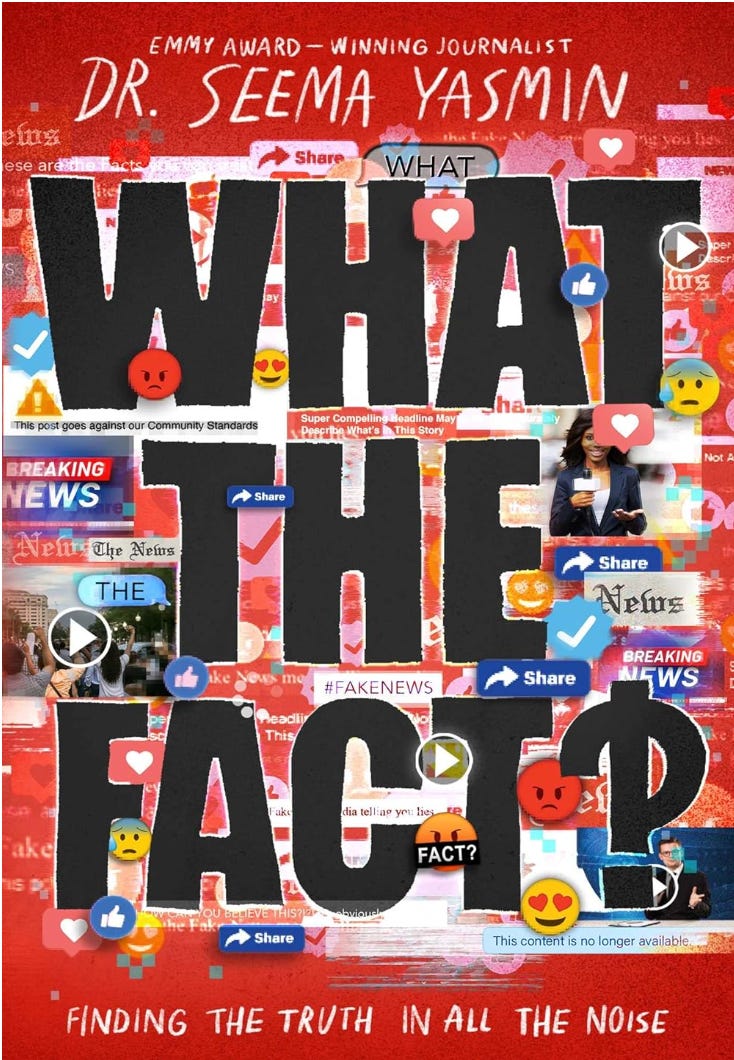
As Dr. Seema Yasmin argues in What the Fact?, misinformation is not primarily a failure of intelligence. Smart people are just as susceptible to falsehoods as anyone else because our beliefs are rarely formed through detached analysis. We absorb information through social relationships, cultural loyalties, and emotional needs. Facts alone do not determine what we believe. Belonging does.
When I recorded the unforgettable conversation I had with the brilliant Dr. Seema Yasmin, this was one of a few things I wrote down. Another was her special name for practicing physicians: “meat mechanics.” There is much to love about this, starting with its aptness — we are, by and large, hunks of meat. When your body collides with metal and concrete while moving fast through space and is torn apart like mine was, you find this out in the most visceral, literal way. We are highly intelligent, electrical, intricate and beautifully organized hunks of meat that are autonomous, self-correcting, self-perpetuating, and self-extinguishing (programmed cell death) biological systems. But the part about her astute euphemism that leapt immediately to the surface of that mountain of love was that I once hallucinated a vivid waking dream while performing a physically challenging form of meditation that lasted days and was done at high elevation in the desert. It was one of those downloads from the Universe that blew my mind wide open and delighted me at the time, but that my built-in skeptic knitted her brow at suspiciously the next day, blaming chemicals in the brain that can behave similarly to and be as powerful as opioids. Especially given the conditions. Nevertheless, the vivid waking dream, and another that happened in the same day, holds as two of the most memorable of my downloads, one of which reminds me of Dr. Yasmin’s nickname for physicians, and both of which somehow soothe the fiery existential angst that lick at me pretty much daily. I wrote about it in a way I feel confident about in my recent memoir in essays, Little Deaths All in a Row, Essays on Sex and Death. I’ll paste it below for your enjoyment. And please also listen to the podcast episode with Dr. Yasmin. It’s one of my favorites.
---
Their cheeks were too red. The genderless worker in the movie theater in an old timey uniform behind the concession stand in the lobby. I walked up and saw, displayed all in a row on wall-mounted shelves behind their head, objects whose wetness and redness initially perplexed me. But then I knew, and of course! Hunks of raw meat took the place of popcorn and candy.
“I’ll have that one,” I said, pointing. The genderless worker pulled wax paper from a roll and grabbed my hunk of meat, half wrapping it, then handing it to me. A bit of its juice spilled over the edges of the paper and onto my hand. As I walked into the theater to take my seat, I inspected my meat more closely. Maybe it wasn’t completely raw, but it was cooked extra rare. I sat down among others in their seats eating their choice cuts. As I waited for the movie to start, I felt a tickle of anticipation, and I took my first bite. I would sit there and watch the movie while consuming my hunk of meat.
This was the hallucination — the waking dream I had while meditating for three days, eight to ten hours each day, with my arms held up in varying positions for durations of an hour at a time. What had me there doing such nonsense that put me in touch, at least metaphorically, with a world beyond death was death’s counterbalance: sex. Not directly, but I was there with my lover at the time, my tenth love, doing what she wanted to do, what she believed would help us in our relationship. This kind of meditation, she said, created the equivalent healing as thousands of hours of talk therapy. And what we probably needed instead was all thousands of those hours.
I’ve cited this waking dream multiple times to friends with existential anxiety, and each time, I’m endlessly delighted by the symbolism. Our bodies are pieces of meat. This became clear when mine was ripped apart during a motorcycle accident that happened like all such things happen: out of the clear blue. Surprised as I was to find I’m just as subject to the laws of physics as anyone else, the most alarming feature of finding myself there on the hood of that car in terrible pain was the sight of my own right hand hanging off by skin, with splintered bone and blood protruding where it used to be. What this made me painfully aware of is humans are animals. We are pieces of meat. And whatever it is we really are — this soul this ghost this consciousness this witness — it’s literally consuming that piece of meat. It’s using it to take a ride on this planet and to experience itself as individual and relative. We can only know ourselves in relation to other people, places, and things. We can only know anything by its relative nature. We can know pleasure only in contrast to pain. Good in contrast to bad. Love in contrast to hate. Young in contrast to old. Hard in contrast to easy.
During another of those physically challenging, arms up meditations, I saw what it is that we really are, and what happens when we die. In the last five minutes of the sixty-two-minute meditation, my body felt on fire with pain. Every muscle was screaming. That’s when I saw it.
My tenth love turned translucent and inside her I could see tiny lights like flashlights at each chakra. From each emanated fluid-like ripples that came together and expanded out. When we die, the lights collapse into one and eject from the body and it feels like coming out of a sixty-two-minute arms up meditation and lying down. Lightness and relief and ecstasy and bliss.
It’s tremendously liberating because, yes, it’s hard to be in a body. They’re dense and spongy and heavy and painful. They absorb everything around them, which is why it’s so important to move and stretch, to literally wring the body out every day. And sleep is very important—it’s the time where this fluid-like light being we really are can recharge by going back to wherever we came from and gather the strength to be in this body another day. The forces at play on our bodies every moment is so much pressure. To begin to fathom this, imagine the earth spinning as it hurtles through space around the sun. The surface of the planet is moving at approximately 1,000 miles per hour. And underneath, dynamic play between the layers, from the deepest interior to the surface, exchanging angular momentum. That spin, counter spin, velocity, combined with the orbital thrust and the whole solar system moving as a unit—all that speed and motion and force—it’s a lot.
Releasing from that arms-up meditation was like the light-fluid releasing from the body. It’s what I came close to experiencing on the hood of that car. But it’s not the whole story. At first, I thought what I was shown gave me the gift I’ve been waiting for: to understand death. But since that day, I’ve had vivid dreams every night and now I know there’s so much more. What I was shown scratched the surface, yes. But even the surface is deep. And all the rest is beyond fathom.