


Dexterity of movement when fingers bend, turning hands into shapes that represent words and phrases. I grew up with American Sign Language (ASL) all around me. My maternal grandparents were Deaf, and my mom’s first language was ASL. She worked as an interpreter. I watched her work: on television in the small square at the lower right of the screen, on the side of a stage, standing beside a speaker at a podium, seated in a chair. Usually, she wore a black top to sharpen the contrast of her pale hands. This made her hands seem to glow. Her face, too, seemed filled with light as she moved and contorted it with exaggerated expressions that serve as the grammar of the language. She was mesmerizing: Her hands flying, fingers creating rapidly changing shapes, carving language into the air, throwing dancing shadows against the wall that look like tiny wild animals, a spatial menagerie.
///
After my hand was torn off, vascular surgeons worked meticulously for hours overnight piecing back together each tendon, ligament, vein. I picture them sometimes, backs bent, magnifying glass over one eye, bright light illuminating the violent red under my skin. I can see it so clearly, it’s almost as if I’m there. As if they could pause, look up at me, and I could see their faces. Their careful work was purposeful. They worked with the intention of restoring the feeling, functionality, and dexterity to my right hand. Later, with a cast over my arm and my fingers poking out from the top, I worked with an occupational therapist named Tina. She massaged my numb fingers and thumb for a while then gave me tasks to perform with my injured hand. Place pegs in holes, squeeze things, hold various objects. The hardest task was to touch each finger in succession to the tip of my thumb.
My thumb felt dead. No feeling, no ability to move it. If I tried and strained very hard, I might see a twitch. Otherwise, it was unresponsive and insensitive. I moved each finger as far as I could, and I couldn’t reach even my pointer to touch my thumb. Day after day, I tried, and one day, it suddenly happened. I could touch the first couple fingers to my thumb. Then all four. The day I first touched all four fingers to my thumb was the first time I remember feeling deep, round, palpable hope. I’d been afraid I wouldn’t be able to use my hand ever again. But this gave me hope I would have full use of my hand again someday, even if not full feeling.
///
Perhaps there is a wisdom in seeing the hand’s design as purposeful. Perhaps labeling “grasping” as negative or as an undesirable action is faulty. When I was a new human, smaller and made up of 100% distinct cells (because they die and are reborn, making the body an ever-changing entity), I grasped my mother’s finger, her breast, her pant leg. I grasped objects and put them into my mouth. Hands and mouths are for exploration and discovery. All new humans instinctually know this. It is this primal knowing we lose along the way. We are taught, as we grow, what to question, what not to, how to behave, what is right, and what is not done. These rules of socialization replace the primal knowing and we stop grasping. We stop using our hands and mouths for exploration and discovery. And although I no longer want to discover more about a centipede by grasping it with my hand and placing it in my mouth as I did when I was a new human, I want to discover more about her that way — the woman who has captured my attention and drawn me into her mind. Or more, her metaphysical heart. Perhaps her soul. This force of attraction I feel makes me want to use my hands and my mouth to explore and discover, uncover what more is there. What sensations. What experiences. Depths perhaps previously unknown to me. Perhaps I was designed to grasp, and I should trust my instincts and my primal knowing more than I trust my cautious, mannered thinking. Perhaps I am meant to grasp and let go, grasp and let go, grasp and let go. This closing and opening of the hand is the natural rhythm of things, of a body falling through space alongside other bodies falling through space.
But what about those sea creatures? All the dark and bright water. The depths to the shallows to the unknowable deep. Its creatures arrive and depart without hands. Slipping through time and space — creatures like scallops, whelks, oysters, clams, mollusks — they never grasp.
///
On my right arm, on the underside of my forearm, there is a neat seam from wrist to elbow pit wherein titanium rods were fitted to replace bones and connect my severed hand back to the soft tissues keeping it alive. The skin of this re-attached hand is thinner and more fragile, easily cut or rubbed off. Perhaps it’s a compromised blood supply, or merely the life drained from the skin when it was separated from its source. The shape of the hand, too, is different. My palm is narrower, the muscles in it less defined. Nevertheless, it functions. It senses. A hand resurrected from death, total numbness, complete paralysis. Facilitated by the interventions of the best medical technology, talents, and minds, my body worked its magic and repaired. Skin grew back together and closed. Nerves regenerated or forged new pathways. With the conditions optimized, my body did what nearly all bodies do unprompted: healed. The seam on that underside of my forearm has always reminded me of a power line, subtly curved as though from gravity, as though with the slight weight of birds. Birds perched. At rest yet alert and ready. Their whole countenance vibrating with the imminence of liftoff, of flight. Skyward, up, up, and gone.
///
When I was small, under the age of ten, and my hands were about half the size of hers, we made the sign for I love you with our two hands stacked. Mine palm side up on hers, middle and ring fingers folded in, hers beneath mine, same fingers folded over. We had our hands photographed this way, captured in black and white. Around the edges, a gathering darkness makes our bright hands look triumphant. Like we’d overcome something together, or like we’d won, and this was our victory grasp.
Now, a few decades later, I can make the same photograph with my children. Preemptively claim a similar victory with them — our love shaped hands chasing back the darkness. Perhaps my mom did it with her parents when she was small, in a time before photographs were easy to take. Her father would have wrapped her small hand in that way, and they would have smiled. And my mom would have thought them triumphant, thought they had won, even well before the game was played out, but the end would come too soon and with defeat. A few decades later, when I was growing in her womb, in her fragile bowl, her father died by suicide. He gripped an electric circular saw and pushed it to his neck. The trigger of the saw is similar to that of a gun — you press with your index finger while gripping the handle to make it work. And when the saw made contact with his neck, his dexterity would have left him finally. His hand would have opened, dropping the saw. He used his own hands to take his own life. He gave his body over to his hands.
But perhaps that doesn’t equate to defeat. Perhaps the gathering darkness around our love and light-filled hands is as friendly and unmenacing as its counterpart. What if both the dark and the light are brimming with gifts?
Sometimes, I look at the photograph of our glowing hands filled with light and I feel it inside me still. Like hope.
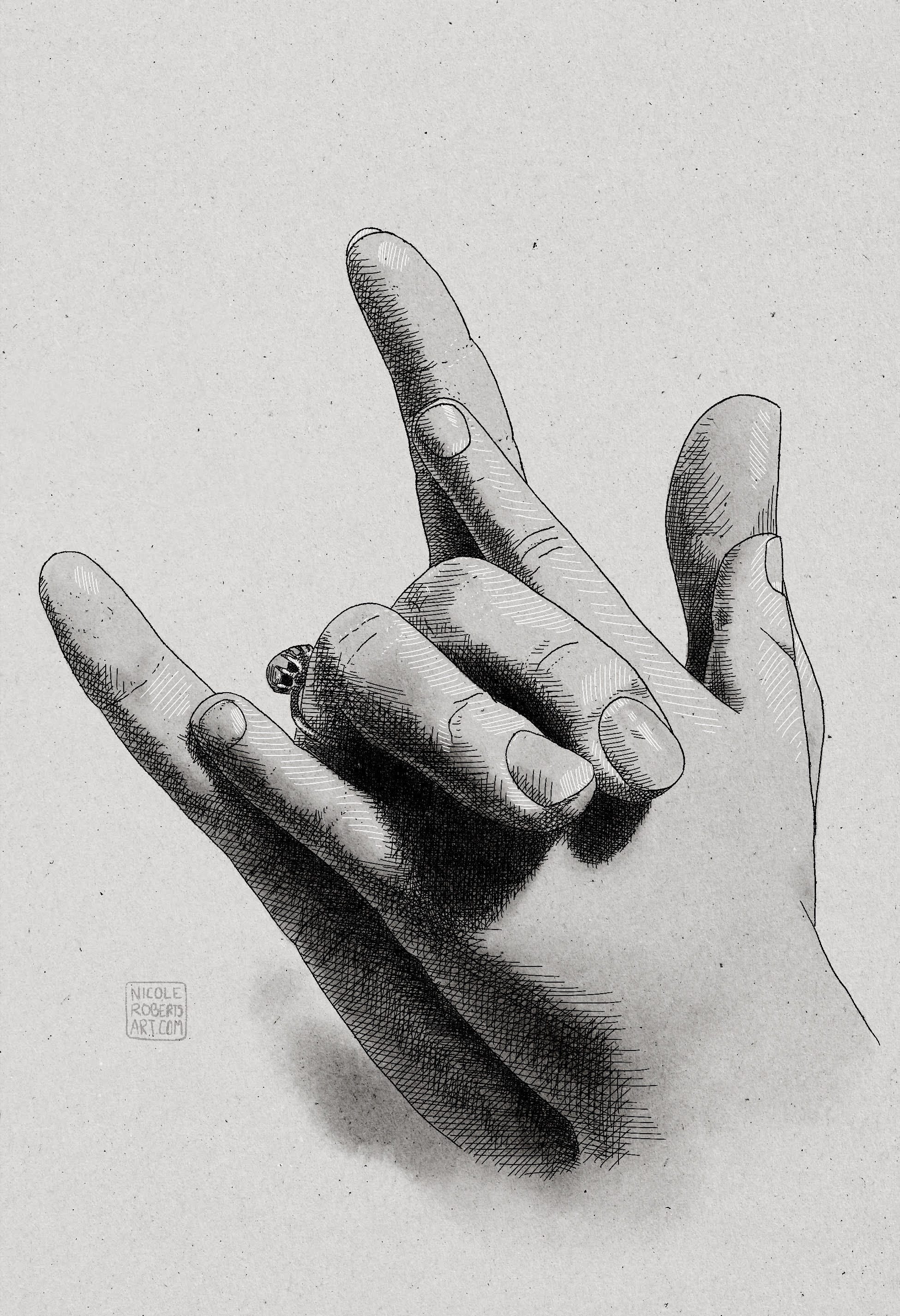
Illustration by Nicole Roberts from “Death, and After” in Little Deaths All in a Row, Essays on Sex and Death
This essay flowed like small streams converging into a powerful river. Beautiful work.