

Knowledge Lives in Pelvises Rebuilt by Miracle
And Forearms Marked by History

“The things I find interesting enough to want to write about are things about which it’s pretty impossible to reach certainty.” — Lilly Dancyger
Resisting certainty is a feminist act.
Certainty is so often the costume power wears. It buttons itself into a lab coat, a clerical collar, a judicial robe. It speaks in footnotes and diagnostic codes. It drafts legislation. It publishes op-eds. It builds categories and calls them natural. It names something normal and, with a sleight of hand, calls everything else deviant.
Certainty does not announce itself as violence. It calls itself order.
But true, flesh-and-warm-blooded people resist neat categories. When known fully — when listened to past the first sentence and the first impression — they defy containment. They contradict themselves. They grow. They betray the boxes built to hold them.
In First Love, Lilly Dancyger refuses not only certainty but genre itself. The book slips between criticism and memoir, between cultural analysis and confession. It writes about first love as romance, yes — but also as addiction, ambition, art, self-destruction. It refuses to stabilize the term. The essays circle rather than march. They contradict. They implicate the narrator even as they critique the culture. In doing so, they enact a radical claim: lived experience is not ancillary to knowledge. It is knowledge.
Genre, like gender, is an authority structure. It tells us what belongs where. Memoir here. Criticism there. Objectivity above. Subjectivity below. Dancyger collapses those hierarchies. She writes criticism as someone with complicity. She writes memoir with the rigor of inquiry. Proximity does not invalidate perception — it sharpens it.
What if we understood queerness the same way? Not as deviation from the norm but as refusal of false binaries. Not as confusion but as complexity.
My oldest and dearest friend — the woman I credit with saving my life twenty-five years ago — is the child of two Holocaust survivors. Both of her parents are gone now, but I had the privilege of knowing them while they were alive.
Her father, Lesley, had the numbers tattooed on his forearm. The identity they gave him. Stripped of his name, his glasses, his clothes, even most of his bodily tissue so that all that remained were haunted eyes in hollowed sockets and skin wrapped tight around bone, the numbers were once the only proof he existed.
When I met him, he was strong again. Older. Filled back in with muscle and fat and fluid — everything organs need to stay vital. He wore button-down shirts with the sleeves rolled up. The numbers visible. He touched them often. Gently. Thoughtfully. Almost reverently.
At twenty-three, I never understood that gesture. I thought survival meant leaving horror behind. I thought healing meant erasure.
Now, with a deep diagonal scar slashing across my own forearm, where my hand was torn off and later reattached, I understand.
My body is haunted by the trauma visited upon it in a near-fatal motorcycle accident 8 years ago. I still wince at the memory of the sight of my hand hanging off by skin and veins. The splintered bone jutting up in its place. I can never unsee that. My pelvis, too, the strong bowl of bones protecting the tender and miracle making organs within, the erotic organs, the orgasm-giving organs — it was crushed. My femoral nerve and artery, one giving vital feeling to my genitals and the other giving life to my whole organism — they were severed. Severed by a sharp fragment of my crushed pubic bone. And perhaps because these are miracle making organs, what followed was nothing shy of a series of miracles that repaired both vital lines named femoral, repaired my sacred bowl of bones, repaired all my injuries, including those not mentioned in this writing.
I was so repaired and so healed, in fact, that most people would never notice, by looking at me, that anything so horrific ever happened to me. And yet. These unseeable things I saw, I can never unsee them. These unspeakable levels of pain I experienced, I will always remember them. They haunt me like demons. Because of them, I fear even the smallest of physical pains. You would think my tolerance for pain would be made greater by such a torment. Not so. The opposite, in fact. This side of surviving that ordeal, I am the biggest baby about pain. And I believe it’s because of the haunting. It’s because I walk around with the ghost severed limb and the ghost dead vagina and the ghost crushed miracle-making organs and the ghost broken bowl tethered to my body. While simultaneously having a healed and stronger-than-before body that I can no more take for granted than make sprout wings and fly. Inside this paradox lies another profoundly uncomfortable and deeply feminist reality. A queer reality.
I am both broken and restored. Terrified and grateful. Haunted and healed.
I reveal my scar often. I touch it often. It stands in bold testimony: I survived something unspeakable.
One Thanksgiving half a lifetime ago with Lesley present, seated around a long table heavy with food and ritual, I made the earnest declaration of someone who still believed in singular truths.
“Love is the most powerful force in the world,” I said.
Lesley looked at me with a mix of shock and indignation.
“That’s not true,” he said evenly. “Hate is by far the most powerful force in the world.”
He punctuated the claim by touching the numbers.
Silence fell like ash. No one reached for their fork.
Chilled, I worried he was right.
Here were two realities colliding at a dinner table: mine, shaped by longing and recovery; his, shaped by genocide. Both of us were speaking from lived experience. Both of us had scars. But the worst of mine were yet to come.
Lesley’s claim about hate was not philosophical. It was empirical. He had seen the machinery of hate industrialized. He had watched institutions decide which lives counted and which did not. He had seen expertise mobilized toward extermination — doctors measuring skulls, lawyers drafting racial codes, theologians blessing the state.
Institutional knowledge has never been neutral.
The Holocaust was not an eruption of chaos; it was an organized project executed by educated men. Authority can be lethal.
And yet. I still believe in love.
Not as a sentimental force, but as a resistant and feminist one. Love is not naïve; it is insurgent. It refuses the categories that hate requires. It sees the person where the system sees a number.
But here is where paradox insists on its place at the table: hate may indeed be more efficient. More scalable. More easily weaponized. Love requires proximity, vulnerability, slowness. Hate can be standardized.
Both truths can coexist.
Queering authority means we do not rush to resolve that tension.
I am both broken and restored. Terrified and grateful. Haunted and healed.
Certainty would demand I choose one narrative. Survivor or victim. Miracle or tragedy. Strong or fragile.
But the truth is both. And neither. And shifting.
If hate is the most powerful force in the world, as Lesley claimed, then what is the role of love? If love is the most powerful force, as I once insisted, how do we account for history’s horrors? And currently unfolding ones?
Maybe the more radical move is not to choose.
Paradox is not a problem to be solved but a state of being to be inhabited.
To queer reality is to widen the circle of who gets to speak it into existence. It asks institutions to loosen their grip on certainty. It asks expertise to bow to embodiment. It asks each of us (especially those closest to power) to interrogate the pleasure we derive from being right.
Because certainty feels good. It feels stabilizing. It feels like safety. But safety built on exclusion is not safety at all.
At that Thanksgiving table, suspended between love and hate, I learned something no classroom had taught me: reality is contested terrain. It is shaped by trauma and by hope. It is inscribed on bodies. It is argued over mashed potatoes. It is revised across generations.
Who gets to know?
The one with the degree.
The one with the pulpit.
The one with the platform.
Yes.
But also the one with the scar.
The one with the tattoo.
The one whose body has been named impossible and who lives anyway.
To resist certainty is not to abandon truth. It is to refuse its monopolization.
It is to say that knowledge does not live only in journals or courtrooms or sanctuaries. It lives in forearms marked by history. In pelvises rebuilt by miracle. In queer desire that refuses correction. In scars.
People, when known fully, will always exceed the categories built to contain them.
And that excess — that unruly, embodied, contradictory excess — is not a threat to reality.
It is reality.
To queer it is simply to tell the truth about how vast it has always been.
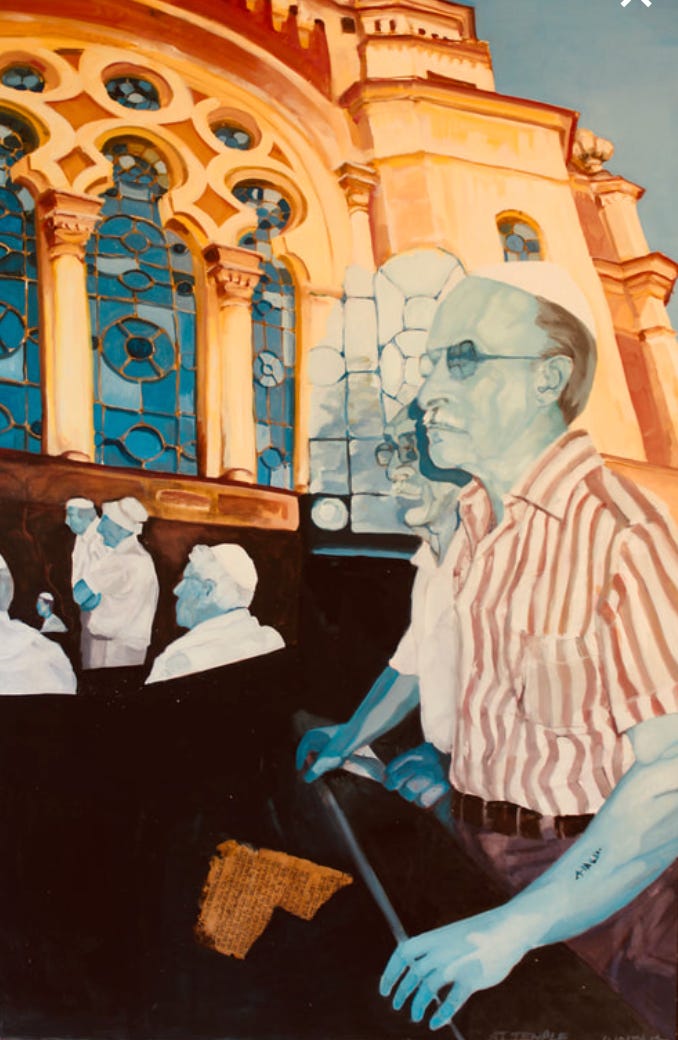
This is a painting of Lesley. The title of the painting is “Survivors Remember” and it was painted by his daughter, Iudita Harlan. It’s part of her collection, Tracing Home.