


I’ve been trying to write about my maternal grandparents for years. They were both deaf, though in very different ways. My grandmother became deaf from an illness at age three. My grandfather was profoundly deaf from birth. The distinction is important, because whereas he came from generations of deaf people with pride in their own rich culture and language, she came from the idea that something had gone wrong with her, and it couldn’t be fixed.
When I spoke with Michelle Duster — the author, historian, and educator who is also a descendant of Ida B. Wells — I was reminded of these stories I carry in my very cells. Histories like spiral staircases winding through time, through epigenetics, through water. Some inheritances arrive as names etched into textbooks. Others arrive as scars, silences, and instincts you don’t remember learning. Most are both.
Listening to her speak about pride and pressure coexisting inside a single lineage clarified something for me: I am not only trying to remember my grandparents. I am trying to understand what it means to live inside a legacy shaped by violence disguised as care, by urgency mistaken for love, by institutions that promised salvation while extracting bodies.
My grandmother, Eloise, did not inherit deafness. It was imposed on her — first by fever, then by everyone who refused to let her remain as she was. When her mother realized Eloise could not hear, she flung her into a frenzy of cures: doctors and specialists, spiritual healers, preachers, even magicians. Her parents were not religious or superstitious, but desperation has a way of flattening belief systems into a single question: what if this works?
They took her to a slaughterhouse first. A neighbor’s preacher’s wife swore a child had once been cured by the scream of a calf echoing off warehouse walls as it was butchered. Eloise remembered only the smell. She closed her eyes through the entire thing. She could not hear the animals, but she felt them — their terror vibrating through her body until she nearly fainted. Her father collapsed before she did, his hand slipping from hers as he fell onto the blood-slick floor. Her mother, buoyant with hope, called Eloise’s name again and again on the drive home, convinced sound might arrive later, delayed but triumphant.
The next day, Eloise was taken into the sky. A small propeller plane climbed higher than she’d ever imagined possible. Pressure built in her head; fear and wonder tangled together. She was certain this would restore her hearing. As the earth fell away beneath her, something else fell away too — unease, gravity, obligation. Suspended in air, she felt curiosity bloom into vast emptiness, a quiet so expansive it felt holy. She realized, then, that what she wanted was not sound but escape.
The pilot pitched the plane into sudden drops, again and again, plunging them toward the earth before pulling back at the last moment. Her ears burned. Her jaw throbbed. Vomit bags filled. The smell drove even the pilot to land early. The sharp falls were supposed to fix her. They did not.
What followed were months of experiments that read like folklore gone feral: twigs lodged in her ears day and night, catheters forced inside, gasoline and lemon juice poured into canals already raw. Her urine was boiled and distilled, dripped back into her head as medicine. Peach pits were fried in hog lard, the oil poured in while still hot, burning her skin and leaving scars that never faded. A mystic gave her a powder she drank dissolved in water. She lost thirty-six hours of memory and returned still deaf.
Eloise’s story is one of relentless intervention — of a body treated as a site of failure to be corrected at any cost. There was no rest. No acceptance. No room for her to become herself. Deafness, for her, was not culture. It was catastrophe.
My grandfather, Charles, came from the opposite world. Deaf from birth, he belonged to a lineage that signed without apology, that understood silence not as absence but as environment. Deafness was not something to cure; it was something to live inside. But even that inheritance could not protect him from the violence of medicine.
At seventeen, Charles entered the Hopemont Sanitarium. It was presented as opportunity. Cutting-edge care. Free treatment. A small stipend. What it was, in reality, was a laboratory. Wealthy families paid to experiment on their sons. Poor families were offered survival in exchange for consent. Charles signed the contract because his family needed the money. His older brother, Lawrence, had already signed. Refusal was not an option that existed.
The surgeries came first — lungs cut, inflated, collapsed. Then gases, injections, restraints. Deaf men and boys disappeared behind doors and did not come back out the same, if at all. Charles began to understand what was happening when patients stopped returning from procedures and nurses stopped using their names.
By the time Charles woke during surgery, ether failing him, his lung exposed and bleeding, he already knew they were not trying to heal him. When the scalpel slipped and pain tore through him so violently that he split from his body, he understood something else as well: if he stayed, he would die there. Lawrence would die there. They all would.
Lawrence did die there. So did every other deaf patient at Hopemont.
Charles survived because he escaped.
This part of the story is not metaphor. He tore himself from the operating table, open-backed and half-conscious, and ran. He climbed through a window. He vanished into the night. He did not look back. He never returned.
Survival, in this lineage, is not noble. It is brutal. It is lonely. It is something you carry like a debt.
Charles lived with the knowledge that he was the only one who made it out. That his brother did not. That entire rooms of men who signed with their hands and laughed with their bodies were erased. There is no monument for them. No archive. Just this story, handed down imperfectly, like a warning.
Later — much later — Charles met Eloise. He taught her sign language, not as therapy but as belonging. He showed her a world where silence was shared, where communication did not require pain. They fell in love. They married. They had two children. One of them was my mother.
For a time, this feels like the redemptive arc history loves to tell. Trauma overcome. Love as cure. But legacy is never that clean.
Charles carried Hopemont inside him for the rest of his life. He carried Lawrence. He carried the dead. And eventually, when my mother was pregnant with me, he chose to die by suicide.
I was not meant to know him. That is how it has always felt — not as abandonment, exactly, but as design. As if survival had limits, and he had reached his.
When Michelle Duster spoke about the divide between public history and private truth, I thought of this. Of how easily stories become flattened into inspiration or tragedy, and how much is lost when we do that. My grandfather is not a cautionary tale. My grandmother is not a symbol of perseverance. They were people shaped by forces that offered no gentleness.
Eloise, at seven, sitting in a storm after running away with torn pages of fairy tales, realized she would never hear again. In rain colored red and blue and orange, she understood she could not give up the world as she saw it. She chose color. She chose presence. She chose to stop being fixed.
That choice echoes forward. It asks me what parts of this inheritance I will carry and which I will refuse. Urgency nearly destroyed them both. The insistence on cure. The belief that rest was a luxury they could not afford.
To honor them is not to mythologize their suffering or sanctify their survival. It is to tell the truth: that love can coexist with harm, that escape does not guarantee peace, that inheritance is as much about what we lay down as what we carry forward.
What I hope to leave behind is not a story of endurance alone, but one of discernment — the knowledge of when to fight and when to stop, when to remember and when to rest. My grandparents were not given that choice. I am. And that, too, is legacy.
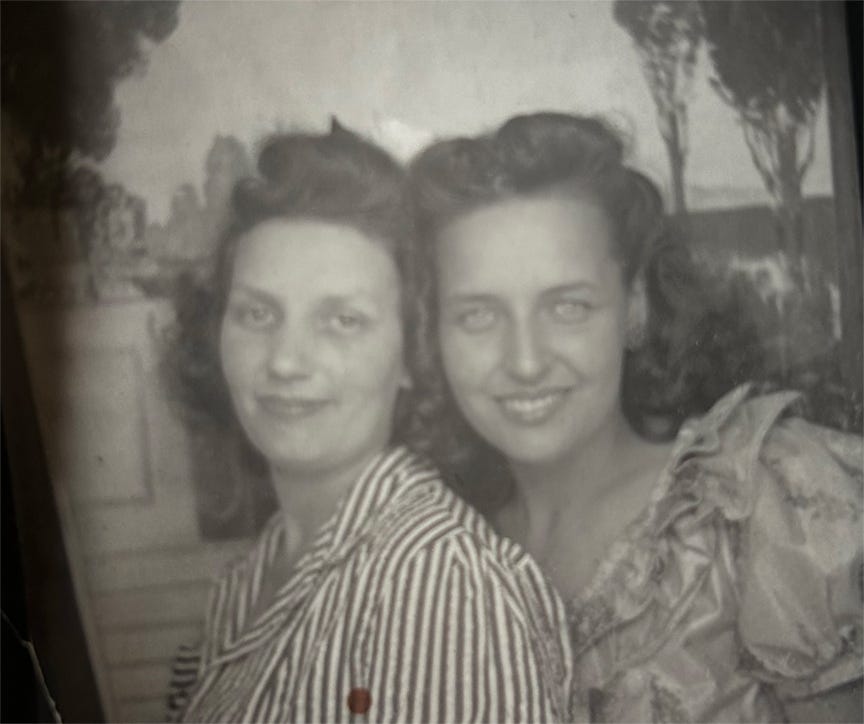
Photo of my grandmother, Eloise (left), with a friend (right).
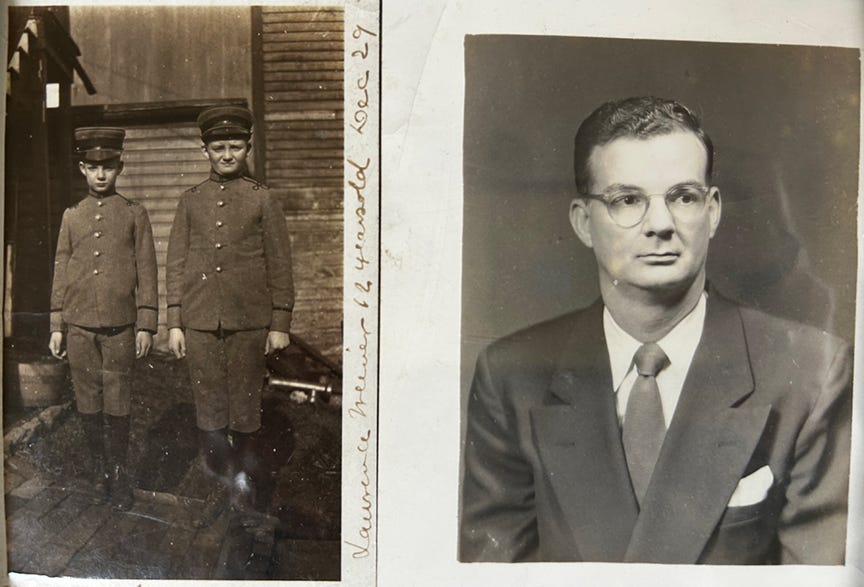
Photos of my grandfather, Charles, younger on the left with his brother, Lawrence (1929), and older on the right.